Ionic Reactions: Acids, Carbocations, Cyclization, and Regiochemistry
Estimated time: minutes
Learning Objectives
- ✓Know the difference between Brønsted acids and Lewis acids and how each activates CBD
- ✓Understand what a carbocation is, why stability matters, and how it forms the key reactive intermediate
- ✓Follow the cyclization mechanism from open CBD to closed THC step by step
- ✓Predict which delta-isomer forms based on the reaction conditions (kinetic vs thermodynamic control)
Lesson 3.1.2 — Ionic Reactions: Acids, Carbocations, Cyclization, and Regiochemistry
Introduction
Lesson 3.1.1 taught you the substrate: the cannabinoid skeleton, the open-versus-closed ring structure, and the double bond position that defines the Δ-isomer. This lesson teaches the reaction that transforms the substrate: acid-catalyzed intramolecular cyclization.
Every acid-catalyzed conversion SOP in this module, regardless of which catalyst it uses, follows the same fundamental sequence: (1) the acid generates a reactive intermediate called a carbocation on the terpene unit, (2) a phenolic oxygen attacks the carbocation to close the pyran ring, and (3) elimination restores a double bond on the C-ring, producing THC. The catalyst type, temperature, solvent, and reaction time determine WHICH double bond position the elimination produces, which is how you control whether you get Δ9-THC, Δ8-THC, or something else entirely.
This lesson teaches you the ionic chemistry toolkit you need to understand every acid-catalyzed conversion SOP. By the end, you will know the difference between Brønsted acids and Lewis acids and how each activates CBD, understand what a carbocation is, why stability matters, and how it forms the key reactive intermediate, follow the cyclization mechanism from open CBD to closed THC step by step, and predict which Δ-isomer forms based on the reaction conditions (kinetic vs thermodynamic control).
Section 1: Two Types of Acids, Two Mechanisms of Activation
Brønsted Acids: Proton Donors
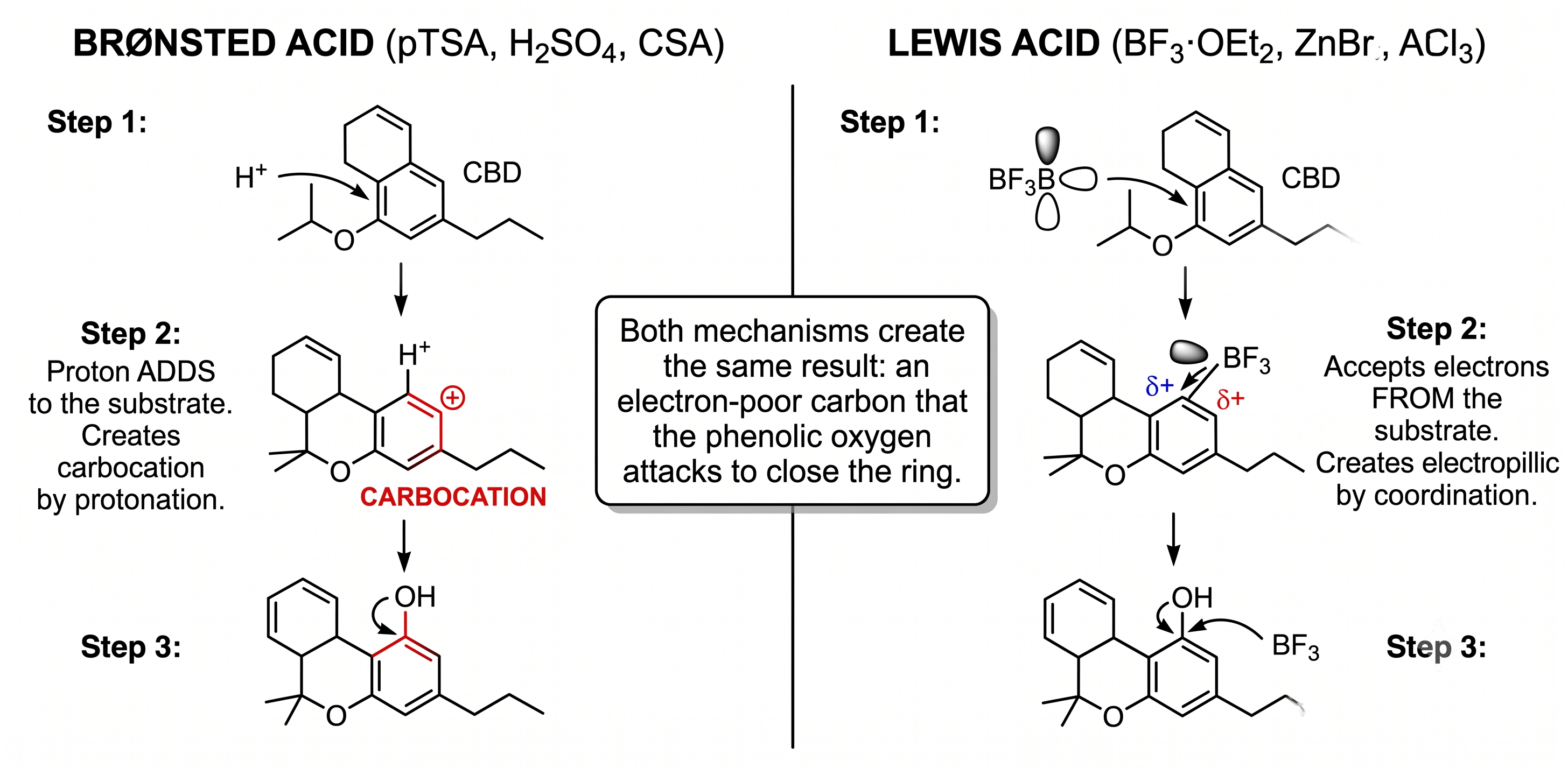
A Brønsted acid is any compound that donates a proton (H+) to the substrate. In cannabinoid conversion chemistry, the most common Brønsted acids are:
para-Toluenesulfonic acid (pTSA): A strong organic acid. Soluble in organic solvents. The workhorse Brønsted catalyst for CBD conversion. Published research (MDPI, 2024) demonstrated that pTSA preferentially produces Δ8-THC. The mechanism involves a pre-cyclization isomerization: pTSA protonates one of CBD's double bonds, causing the double bond to shift position BEFORE the ring closes. The shifted double bond then cyclizes to produce Δ8-THC directly, rather than forming Δ9-THC and then isomerizing.
Sulfuric acid (H2SO4): A strong mineral acid. Powerful but less selective. Used in some older conversion protocols. More prone to over-reaction, side products, and degradation of the product if reaction time is not carefully controlled.
Camphorsulfonic acid (CSA): A chiral Brønsted acid. Published data (ACS J. Natural Products, 2020) showed CSA produces Δ9-THC in good yields under readily accessible conditions. Less studied than pTSA but a viable alternative with potentially better selectivity for Δ9.
How Brønsted acids activate CBD: The proton (H+) adds across one of CBD's double bonds (a reaction called protonation of an alkene). This breaks the double bond and generates a carbocation: a carbon atom carrying a positive charge because it has lost one of its bonds to the departing electron pair. The carbocation is the reactive intermediate that enables the ring closure.
Why Brønsted acids favor Δ8: A free proton is infinitesimally small. It has an extremely high charge density and rapid diffusion kinetics. It hops on and off BOTH the exocyclic isopropenyl double bond AND the endocyclic cyclohexene double bond with nearly equal ease, because it is too small to be sterically excluded from either site. This rapid, unselective protonation of both double bonds is why Brønsted acids are notorious for rushing past the kinetic Δ9 product and driving the reaction into the Δ8 thermodynamic sink. The proton can reprotonate the inherited Δ9 double bond almost as fast as it catalyzes the initial cyclization.
Lewis Acids: Electron Pair Acceptors
A Lewis acid is any compound that accepts an electron pair from the substrate. It does not donate a proton. Instead, it coordinates with the electron-rich double bond, pulling electron density away from the carbon and making it electrophilic (susceptible to nucleophilic attack).
Boron trifluoride etherate (BF3·OEt2): The most commonly used Lewis acid for CBD conversion. Boron has an empty orbital that accepts electron density from CBD's double bond. Published research shows BF3·OEt2 preferentially produces Δ9-THC (50-60% yield) with approximately 20% iso-THC as a byproduct. The mechanism proceeds through tertiary carbenium ion (carbocation) intermediates.
Zinc bromide (ZnBr2): A milder Lewis acid. Used in some conversion protocols where BF3 is too aggressive.
Aluminum chloride (AlCl3): A strong Lewis acid. Published patent data (US 8,106,244) demonstrated 10:1 selectivity for Δ9-THC over iso-THC at very short reaction times. Extended reaction time causes isomerization of Δ9 to the thermodynamically more stable Δ8.
How Lewis acids activate CBD: The Lewis acid coordinates with the π electrons of CBD's double bond, forming a complex that makes the adjacent carbon electrophilic. This electrophilic carbon is then attacked by the nucleophilic phenolic oxygen, forming the new C-O bond and closing the pyran ring. The Lewis acid is regenerated (it is a catalyst, not consumed).
Why Lewis acids favor Δ9: Unlike a bare proton, Lewis acid molecules (BF3·OEt2, AlCl3) are bulky. They carry ligands (etherate, chlorides) that create significant steric volume around the catalytic center. When these bulky complexes approach CBD, they preferentially coordinate with the sterically accessible exocyclic isopropenyl double bond, which protrudes from the ring into open space. The endocyclic double bond, buried within the cyclohexene ring and flanked by adjacent C-H bonds and the ring skeleton, is sterically hindered and much harder for the bulky Lewis acid to access. This steric selectivity is the physical reason Lewis acids produce higher Δ9-THC yields: they preferentially catalyze the desired isopropenyl cyclization while leaving the endocyclic double bond (and thus the inherited Δ9 position) untouched for longer.
This selectivity is not absolute. Published data shows BF3·OEt2 still produces approximately 20% iso-THC (from endocyclic activation), and extended reaction time allows even Lewis acids to eventually isomerize Δ9 to Δ8. Steric hindrance creates a preference, not a guarantee. This is why reaction time monitoring remains essential even with Lewis acid catalysts.
Section 2: The Carbocation — Why It Matters
The carbocation is the key intermediate in every acid-catalyzed cannabinoid conversion. Understanding carbocation stability explains why certain products form preferentially, why some catalysts give better selectivity than others, and why reaction conditions shift the product distribution.
What a Carbocation Is
A carbocation is a carbon atom with only three bonds instead of the usual four. It carries a formal positive charge because it has an empty orbital where its fourth bond would be. This makes the carbon intensely electrophilic: it is electron-poor and actively attracts any nearby nucleophile (electron-rich atom) to form a new bond.
In the CBD cyclization, the carbocation is the carbon that the phenolic oxygen attacks to form the new C-O ether bond of the pyran ring.
Carbocation Stability
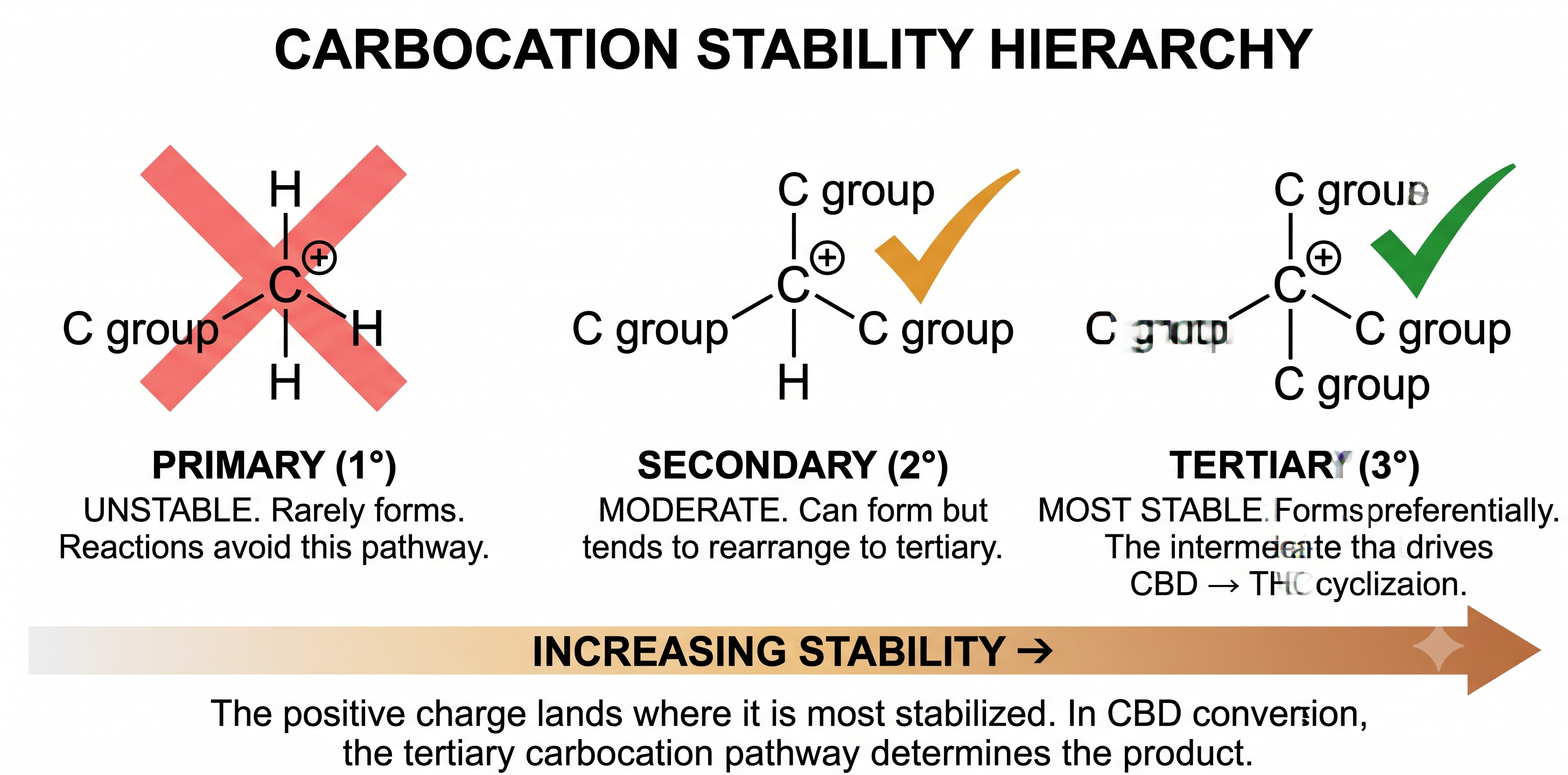
Not all carbocations are equal. The stability of a carbocation depends on how many carbon groups are attached to the positively charged carbon:
Tertiary carbocation (3°): Three carbon groups attached. Most stable. The surrounding carbons donate electron density through hyperconjugation, partially stabilizing the positive charge. Tertiary carbocations form preferentially and persist long enough for the ring closure to occur cleanly.
Secondary carbocation (2°): Two carbon groups. Moderately stable. Can form but tends to rearrange to a more stable tertiary carbocation if possible.
Primary carbocation (1°): One carbon group. Unstable. Rarely forms in solution. If a reaction pathway requires a primary carbocation, it typically does not proceed through that pathway.
Why This Matters for CBD Conversion
When the acid protonates (Brønsted) or coordinates with (Lewis) one of CBD's double bonds, the resulting carbocation can form at different carbon positions depending on which carbon gets the positive charge. The positive charge preferentially lands on the carbon that gives the most stable carbocation (tertiary over secondary). This preference determines which cyclization pathway occurs and, ultimately, which product forms.
Published molecular modeling (MDPI, 2024) confirmed that BF3·OEt2 catalysis proceeds through tertiary carbenium ion transition states, which is why it preferentially produces Δ9-THC. The tertiary carbocation pathway directly leads to the Δ9 product.
Section 3: The Cyclization Mechanism — Step by Step
Here is the complete mechanism of acid-catalyzed CBD to THC conversion, step by step. This is the reaction you will be running in every acid-catalyzed SOP.
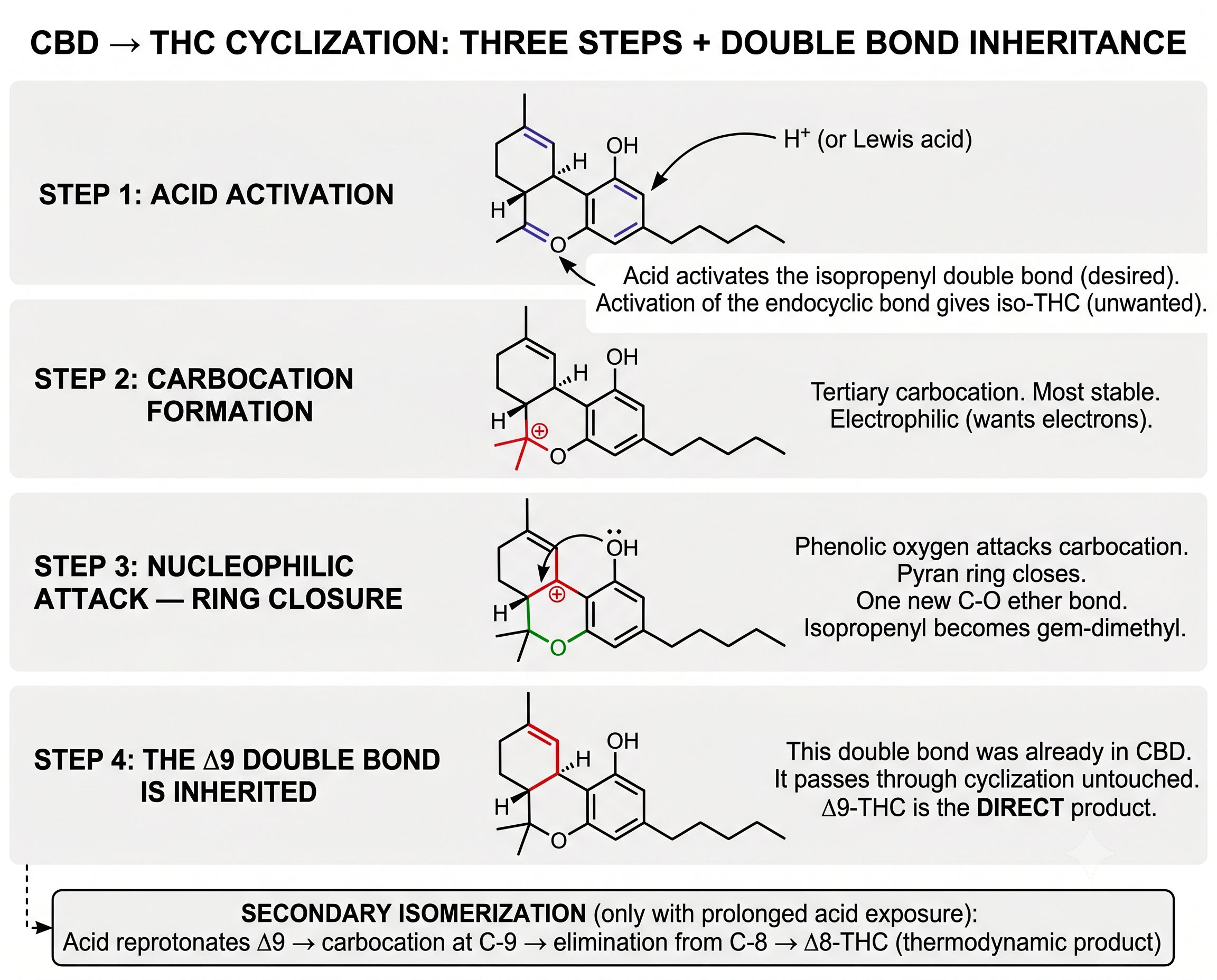
Step 1: Acid Activation
The acid (Brønsted or Lewis) activates one of CBD's double bonds. CBD has two double bonds that are potential sites for acid activation:
The isopropenyl double bond (the exocyclic =C(CH3)2 group on the cyclohexene ring). Activation here leads to the THC scaffold (Δ9-THC or Δ8-THC). This is the desired pathway for THC production.
The endocyclic double bond (within the cyclohexene ring itself). Activation here leads to the iso-THC scaffold (Δ8-iso-THC or Δ4(8)-iso-THC). This is an unwanted side reaction that produces an isomer with different (and largely unstudied) pharmacological properties.
The catalyst selectivity for one double bond over the other is what determines how much THC vs iso-THC you produce. Published data shows Lewis acids like AlCl3 at short reaction times achieve 10:1 THC:iso-THC selectivity (US Patent 8,106,244), while BF3·OEt2 gives approximately 50-60% Δ9-THC with ~20% iso-THC.
Step 2: Carbocation Formation
Protonation of (or Lewis acid coordination with) the isopropenyl double bond generates a tertiary carbocation at the central carbon of what will become C-6 in THC. This carbon now carries a positive charge and an empty orbital. It is electrophilic: it wants electrons.
Step 3: Nucleophilic Attack — Ring Closure
One of CBD's two aromatic phenolic hydroxyl groups (the nucleophile, with lone pair electrons on the oxygen) attacks the electrophilic carbocation. The oxygen's lone pair fills the carbocation's empty orbital, forming a new C-O bond. This bond is the ether linkage of the pyran ring.
The ring snaps closed. CBD's open two-ring system becomes THC's closed three-ring system in a single bond-forming event. The isopropenyl group transforms into the gem-dimethyl at C-6 (the two methyl groups that were part of the =C(CH3)2 are now on a saturated carbon).
Step 4: The Δ9 Double Bond Is Inherited, Not Created
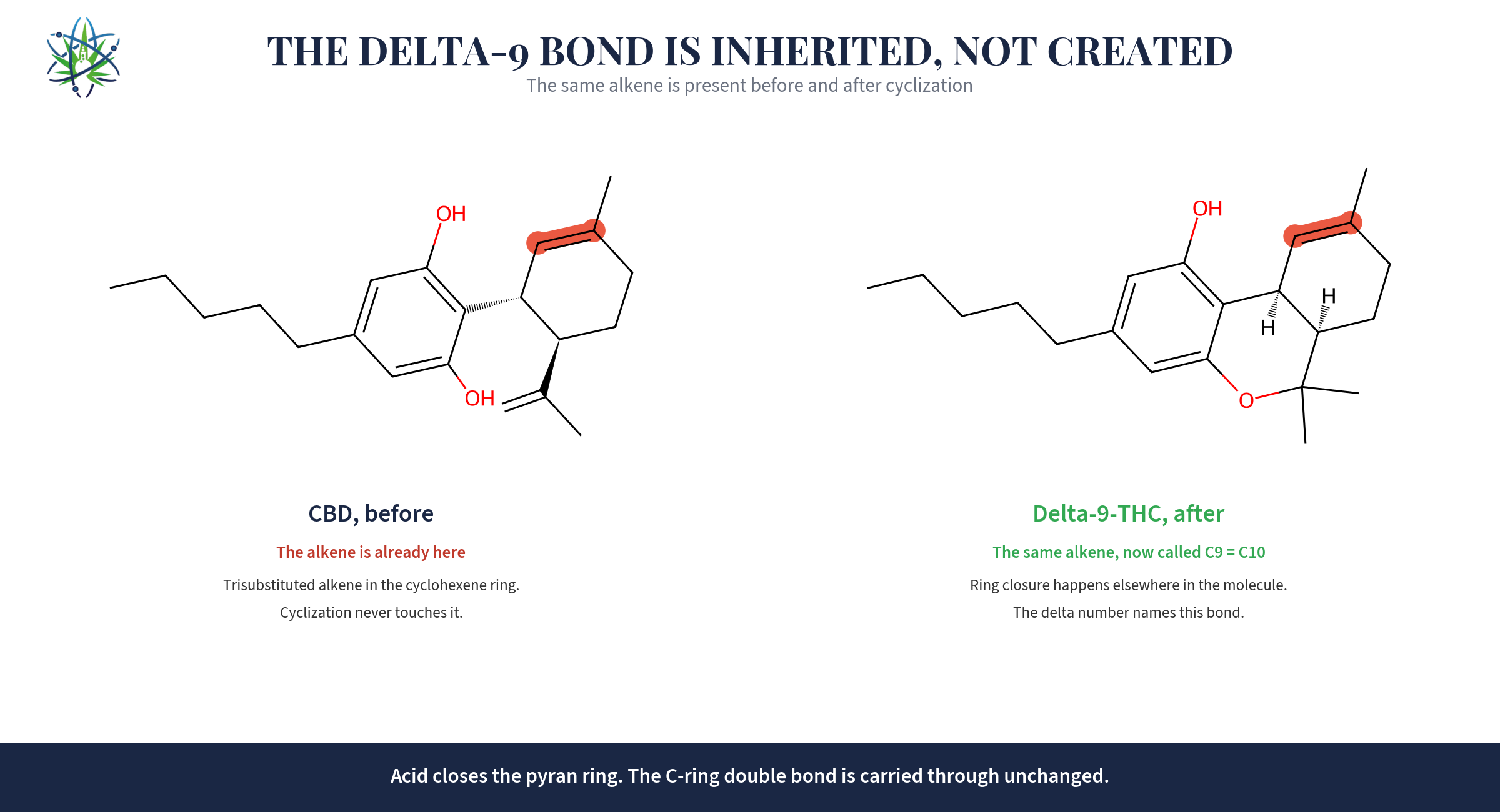
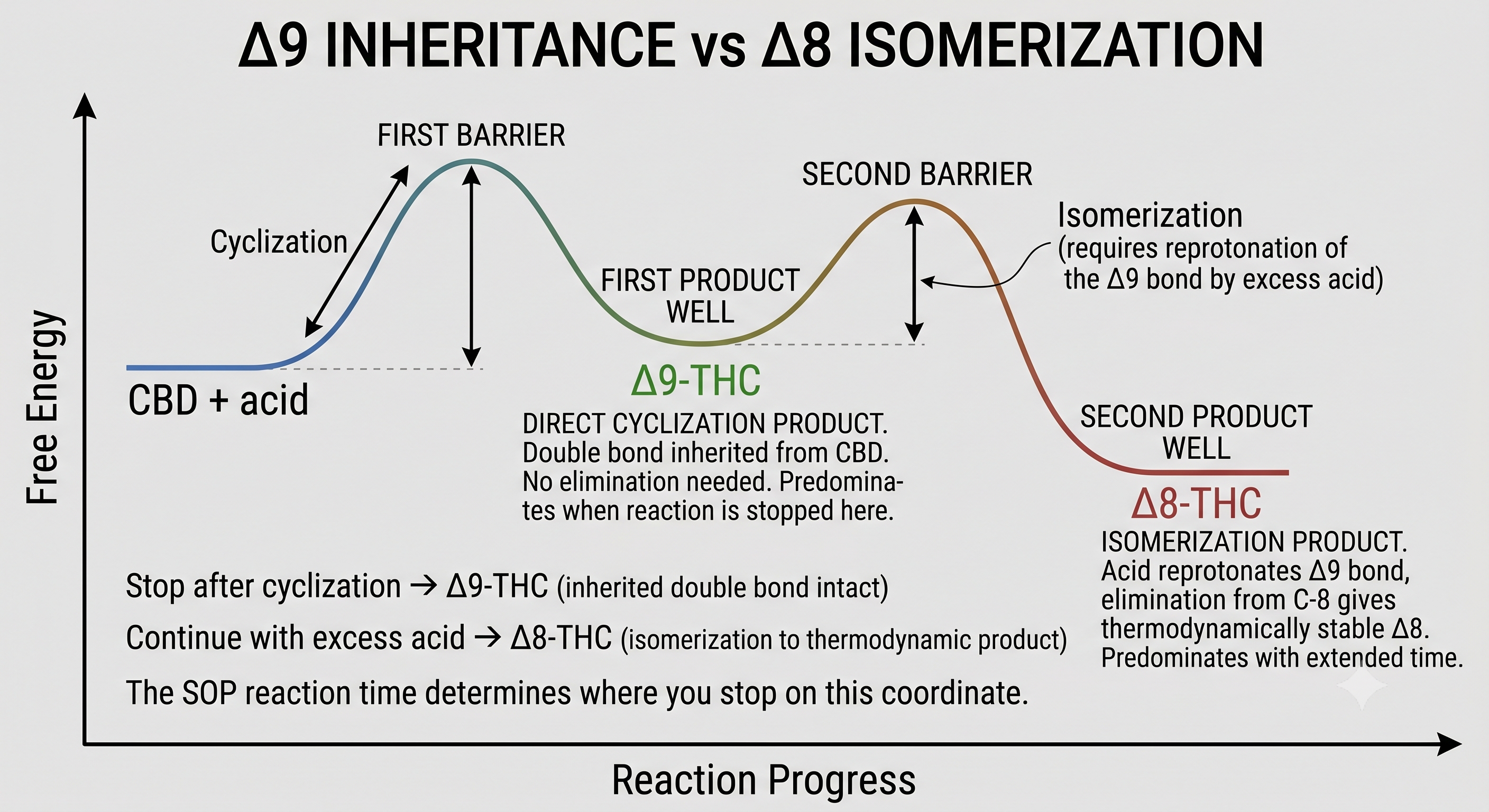
A critical point that most descriptions of this reaction get wrong: the Δ9 double bond (C9-C10) in Δ9-THC is NOT formed during the cyclization. It is inherited directly from the starting CBD.
CBD's cyclohexene ring already contains an endocyclic double bond at the position that maps to C9-C10 in THC. During the entire cyclization sequence (Steps 1-3), only the EXOCYCLIC isopropenyl double bond is consumed (protonated, converted to a carbocation, then to the gem-dimethyl upon ring closure). The endocyclic double bond on the cyclohexene ring is completely untouched. It passes through the reaction intact.
This means Δ9-THC is the direct, unmodified product of a clean cyclization. No elimination step is needed to "create" the Δ9 double bond. It was already there in CBD.
How Δ8-THC Forms: The Secondary Isomerization
Δ8-THC does NOT form through a different cyclization pathway. It forms through a SECONDARY isomerization of the Δ9-THC that was already produced.
Under prolonged or harsh acidic conditions, the acid reprotonates the inherited Δ9 double bond (C9-C10). This generates a new carbocation at C-9 (which is tertiary, stabilized by the adjacent methyl group and alkyl substituents). Now an elimination reaction occurs: a proton is abstracted from the adjacent C-8 position, and the electrons that bonded that proton to C-8 collapse to form a new double bond between C-8 and C-9. This is the Δ8 position.
The Δ8 double bond is tetrasubstituted (four carbon groups attached to the two doubly-bonded carbons), while the Δ9 double bond is trisubstituted (three carbon groups). More substituted alkenes are more thermodynamically stable (Zaitsev's rule). This is why Δ8 is the thermodynamic product: given enough time and acid, the double bond migrates from the less stable Δ9 position to the more stable Δ8 position.
The operational implication is unchanged: short time = Δ9 (because the inherited double bond has not yet been isomerized). Long time = Δ8 (because the acid has had time to reprotonate and isomerize the double bond). But the mechanism is different from what is commonly described: Δ9 is not a kinetic product of elimination. It is the direct product of cyclization with an inherited double bond. Δ8 forms only through subsequent acid-catalyzed isomerization of Δ9.
Section 4: Regiochemistry — Why Δ8 Forms From Δ9
As established in Section 3, Δ9-THC is the direct product of cyclization: the C9-C10 double bond is inherited intact from CBD. No regiochemical "choice" is made during the primary reaction. The question is not "which double bond forms during cyclization" but rather "does the inherited double bond stay where it is, or does the acid isomerize it?"
This isomerization is where regiochemistry enters the picture.
The Isomerization Mechanism
Under continued acid exposure after cyclization is complete, the acid can reprotonate the Δ9 double bond (C9-C10). This generates a tertiary carbocation at C-9. From this carbocation, elimination can occur in two directions:
- Proton loss from C-10 regenerates the original Δ9 double bond (no net change, the system returns to where it started)
- Proton loss from C-8 generates the Δ8 double bond (C8-C9), which is tetrasubstituted and thermodynamically more stable
Over time, the repeated protonation-elimination cycling drives the equilibrium toward the more stable Δ8 position. This is thermodynamic control: given enough time and acid, the double bond migrates from the less substituted (Δ9, trisubstituted) to the more substituted (Δ8, tetrasubstituted) position.
Zaitsev's Rule
Zaitsev's rule states that elimination reactions preferentially form the most substituted alkene (the double bond surrounded by the most carbon groups). The most substituted alkene is generally the most thermodynamically stable.
Applied to the Δ9→Δ8 isomerization:
- Δ8-THC has the double bond between C-8 and C-9. This position is tetrasubstituted (four carbon groups attached to the double bond carbons) and thermodynamically more stable.
- Δ9-THC has the double bond between C-9 and C-10. This position is trisubstituted and less thermodynamically stable, but it is the INHERITED double bond from CBD. It requires no elimination to form.
Why Time and Conditions Determine the Product
Short reaction time, mild conditions: The cyclization completes, producing Δ9-THC with the inherited double bond. The acid has not had time to reprotonate and isomerize the Δ9 bond. Product: predominantly Δ9-THC.
Long reaction time, harsh conditions: After cyclization is complete, the excess acid continues to interact with the product. The Δ9 double bond gets reprotonated, the carbocation forms at C-9, and elimination from C-8 produces Δ8-THC. Given enough time, the equilibrium shifts heavily toward Δ8. Product: predominantly Δ8-THC.
What This Means in the Lab
Published data confirms this framework across multiple catalyst systems:
pTSA (Brønsted): Preferentially produces Δ8-THC. The molecular modeling study (MDPI, 2024) showed that pTSA isomerizes CBD's double bond BEFORE ring closure, effectively pre-selecting the Δ8 outcome. pTSA under standard reflux conditions gives thermodynamic control from the start.
BF3·OEt2 (Lewis): Preferentially produces Δ9-THC (50-60% yield) through tertiary carbenium ion transition states. The bulky Lewis acid complex selectively activates the exocyclic isopropenyl, preserving the inherited Δ9 double bond. However, if the reaction runs too long, BF3 will isomerize the Δ9 product to Δ8 (the "inherent problem of isomerization" noted in US Patent 8,106,244).
AlCl3 (Lewis): At very short reaction times, achieves 10:1 selectivity for Δ9-THC over iso-THC, with minimal isomerization to Δ8. Extended reaction time favors Δ8 formation. This is the clearest published demonstration of kinetic vs thermodynamic control in cannabinoid conversion.
CSA (Brønsted): Produces Δ9-THC under mild conditions. Less data available but appears to operate under kinetic control.
The Operator's Lever
You do not need to understand every orbital interaction in the transition state. You need to understand one operational principle:
Short reaction time + mild conditions = more Δ9-THC (the inherited double bond survives). Long reaction time + harsh conditions = more Δ8-THC (the acid isomerizes the inherited bond).
Every conversion SOP specifies a reaction time and temperature. These are not arbitrary. They are calibrated to produce the desired ratio of Δ9 to Δ8 by controlling how much post-cyclization isomerization occurs. Running past the specified time, or at a higher temperature than specified, gives the acid more opportunity to reprotonate and isomerize the Δ9 bond. This is not a theoretical concern. It is the most common source of off-spec conversion product in production.
Section 5: The iso-THC Problem
Not all cyclization goes through the desired pathway. When the acid activates the endocyclic double bond (inside the cyclohexene ring) instead of the isopropenyl double bond, the ring closure produces a different structural scaffold: iso-THC.
What iso-THC Is
iso-THC isomers (Δ8-iso-THC, Δ4(8)-iso-THC) have the pyran ring closed in a different position than regular THC. The three-ring system is present, but the ring junction geometry is different. The pharmacological effects of iso-THC isomers are largely unstudied. They are unwanted byproducts.
Why iso-THC Forms
The endocyclic double bond in CBD's cyclohexene ring is also susceptible to acid activation. If the acid protonates (or coordinates with) this double bond instead of the isopropenyl, the resulting carbocation leads to cyclization along a different pathway. The phenolic oxygen attacks a different carbon, closing the ring in the iso configuration.
Minimizing iso-THC
Catalyst selection is the primary control:
- AlCl3 at short reaction times: 10:1 THC:iso-THC (excellent selectivity)
- BF3·OEt2: approximately 50-60% Δ9-THC, ~20% iso-THC (moderate selectivity)
- pTSA: produces primarily Δ8-THC with less iso-THC than BF3 (different mechanism avoids the endocyclic pathway)
Temperature also matters: lower temperatures generally favor the desired isopropenyl activation pathway because the activation energy for the endocyclic pathway is higher. Higher temperatures provide enough energy to access both pathways, reducing selectivity.
Every conversion SOP's catalyst choice and reaction conditions are designed to maximize the desired THC isomer while minimizing iso-THC. When an operator deviates from the SOP (wrong catalyst loading, wrong temperature, wrong time), iso-THC formation increases. Analytical monitoring (HPLC during the reaction, covered in later lessons) catches this before the batch is committed.
Section 6: Solvent Effects
The solvent is not an inert bystander. It participates in the reaction by solvating (surrounding and stabilizing) the intermediates, influencing which pathway predominates.
Polar vs Nonpolar Solvents: Dielectric Constants and Carbocation Lifetimes
The solvent's dielectric constant determines how effectively it stabilizes charged intermediates, which directly controls the carbocation's lifetime and therefore the product distribution.
Polar aprotic solvents (dichloromethane, acetonitrile): High dielectric constants. These solvents form a tight solvent cage around the newly formed carbocation through electrostatic interactions, artificially extending its lifetime. A long-lived carbocation has time to undergo unfavorable side reactions: hydride shifts, skeletal rearrangements, and rotation to access the endocyclic double bond for iso-THC cyclization. Published data (ACS J. Nat. Prod.) confirmed this directly: acetonitrile at -10°C yielded Δ8-iso-THC as the main product, a dramatically different outcome from the same reaction in nonpolar solvent. The polar solvent stabilized the carbocation long enough for the unfavorable rearrangement pathway to compete with the desired cyclization.
Nonpolar aprotic solvents (toluene, heptane): Low dielectric constants. These solvents provide virtually no electrostatic stabilization of the carbocation. The carbocation is "naked," highly reactive, and short-lived. It must react with the nearest available nucleophile immediately, which is the phenolic hydroxyl group positioned right next to it on the same molecule. Nonpolar solvents essentially force instantaneous, clean intramolecular ring closure before side rearrangements have time to manifest. This is why most high-selectivity conversion SOPs use toluene or DCM (moderate polarity) rather than acetonitrile (high polarity).
Protic vs Aprotic Solvents
Protic solvents (ethanol, methanol): Can donate protons, potentially interfering with the acid catalyst or participating in side reactions. Generally avoided for CBD conversion unless the SOP specifically calls for them.
Aprotic solvents (DCM, toluene, acetonitrile): Cannot donate protons. The acid catalyst operates without solvent interference. Most conversion SOPs use aprotic solvents.
The Takeaway for Operators
The SOP specifies the solvent for a reason. The solvent was selected as part of the method optimization to produce the target product distribution. Substituting a different solvent (even one that "seems equivalent") can dramatically alter the product ratio, the iso-THC content, and the reaction rate. Use the specified solvent. If the specified solvent is unavailable, do not proceed with a substitute without re-validating the method.
Key Concepts
-
Brønsted acids donate protons; Lewis acids accept electron pairs. Both generate electrophilic carbocations that enable the cyclization. pTSA (Brønsted) favors Δ8-THC. BF3·OEt2 (Lewis) favors Δ9-THC. The catalyst determines the product.
-
Carbocation stability (3° > 2° > 1°) determines which pathway the reaction follows. Tertiary carbocations form preferentially. The tertiary carbocation pathway leads to the THC scaffold. Unstable carbocations rearrange or lead to unwanted byproducts.
-
The cyclization is three steps: activation → carbocation → ring closure. The Δ9 double bond is inherited from CBD, not created by elimination. No elimination occurs during the primary cyclization.
-
Δ9-THC is the direct cyclization product. Δ8-THC requires a secondary isomerization. Short time preserves the inherited Δ9 bond. Long time allows the acid to reprotonate Δ9 and isomerize it to the thermodynamically stable Δ8 (tetrasubstituted > trisubstituted). The SOP reaction time controls where you stop on this coordinate.
-
iso-THC forms when the wrong double bond is activated. CBD has two double bonds. Isopropenyl activation → THC. Endocyclic activation → iso-THC. Catalyst choice and temperature control which bond is activated.
-
The solvent affects selectivity through carbocation lifetime. Polar solvents (high dielectric) stabilize the carbocation, extending its lifetime and enabling rearrangements (iso-THC). Nonpolar solvents leave the carbocation naked, forcing immediate clean cyclization. Use the SOP-specified solvent. Do not substitute without re-validation.
Exercise
Part A — Catalyst Selection
An operator needs to produce a batch that is >70% Δ9-THC with minimal Δ8-THC and minimal iso-THC.
- Should they use a Brønsted acid (pTSA) or a Lewis acid (BF3·OEt2 or AlCl3)? Explain why.
- Which Lewis acid offers the best documented selectivity for Δ9-THC over iso-THC?
- How should they manage reaction time to maximize Δ9 and minimize Δ8?
Part B — Mechanism Tracing
Trace the three-step cyclization mechanism for CBD → Δ9-THC using BF3·OEt2 as the Lewis acid catalyst:
- What does BF3 do to CBD's isopropenyl double bond?
- What type of carbocation forms, and at which carbon?
- What nucleophile attacks the carbocation, and what bond forms?
- After ring closure, where does the Δ9 double bond in the product come from? Does an elimination reaction occur during the primary cyclization?
Part C — Troubleshooting
A conversion batch was set up with the following parameters:
- Catalyst: pTSA (Brønsted acid)
- Solvent: toluene (reflux)
- Reaction time: 4 hours (SOP calls for 2 hours)
HPLC analysis of the product shows:
- Δ8-THC: 72%
- Δ9-THC: 8%
- iso-THC: 12%
- Unreacted CBD: 3%
- Unknown peaks: 5%
- Is this result expected for pTSA? Explain using the mechanism from Section 4.
- The SOP called for 2 hours. The operator ran for 4 hours. How did this affect the product distribution?
- What are the "unknown peaks" most likely to be?
- What would you recommend changing to increase the Δ9-THC fraction?
Checkpoint Answers
Part A
-
Lewis acid (AlCl3 or BF3·OEt2). Brønsted acids like pTSA preferentially produce Δ8-THC through a pre-cyclization isomerization mechanism. For >70% Δ9-THC, a Lewis acid is required because Lewis acid catalysis proceeds through tertiary carbenium ion transition states that favor the Δ9 product.
-
AlCl3 offers the best documented selectivity: 10:1 Δ9-THC:iso-THC at short reaction times (US Patent 8,106,244). BF3·OEt2 gives only 50-60% Δ9-THC with ~20% iso-THC. AlCl3 is the stronger documented performer for Δ9 selectivity.
-
Use short reaction times and monitor by HPLC. At short reaction times, kinetic control predominates and Δ9-THC is the major product. As reaction time increases, the Lewis acid promotes isomerization of Δ9 to the thermodynamically more stable Δ8. The operator should monitor the reaction by pulling aliquots for HPLC analysis, and stop the reaction (quench the catalyst) when the Δ9-THC concentration peaks, before significant isomerization to Δ8 occurs.
Part B
-
BF3 coordinates with the π electrons of CBD's isopropenyl double bond. The boron atom in BF3 has an empty orbital that accepts electron density from the double bond, forming a BF3-alkene complex. This pulls electron density away from the carbon, making it electrophilic.
-
A tertiary carbocation forms at the central carbon of the isopropenyl group (future C-6 in THC). It is tertiary because the positively charged carbon is bonded to three carbon groups (the two methyl groups and the cyclohexene ring carbon). Tertiary is the most stable carbocation class.
-
One of CBD's two aromatic phenolic hydroxyl oxygens (the nucleophile) attacks the tertiary carbocation (the electrophile). The oxygen's lone pair electrons fill the carbocation's empty orbital, forming the new C-O ether bond. This bond closes the pyran ring, converting CBD's open two-ring system into THC's closed three-ring tricyclic system. The isopropenyl becomes the gem-dimethyl at C-6.
-
The Δ9 double bond is inherited directly from CBD's cyclohexene ring. CBD already contains an endocyclic double bond at the position that maps to C9-C10 in THC. During the cyclization (Steps 1-3), only the exocyclic isopropenyl double bond is consumed. The endocyclic double bond passes through untouched. No elimination reaction occurs during the primary cyclization. Elimination only occurs later, during the secondary isomerization of Δ9→Δ8 under prolonged acid exposure.
Part C
-
Yes, this result is expected for pTSA. Published research (MDPI, 2024) established that pTSA preferentially produces Δ8-THC through pre-cyclization isomerization of CBD's double bond. The 72% Δ8-THC is consistent with pTSA's known thermodynamic selectivity. pTSA is not the correct catalyst for Δ9-THC production.
-
Running for 4 hours (double the specified 2 hours) pushed the system further toward thermodynamic products. The extended time allowed additional isomerization of any Δ9-THC that had formed early in the reaction into Δ8-THC (explaining the low 8% Δ9). It also allowed increased formation of iso-THC byproducts (12%), which accumulate as the system explores additional reaction pathways over time. The 5% unknown peaks are also likely thermodynamic byproducts that form with extended reaction time.
-
The unknown peaks are most likely: oligomeric byproducts from acid-catalyzed polymerization of the double bonds (over-reaction products that form when acid exposure is prolonged), degradation products from extended heat exposure (reflux temperature in toluene is approximately 111°C), or additional cannabinoid isomers (Δ10-THC, Δ4(8)-iso-THC, abnormal cannabinoids) that form through rearrangement pathways accessible at extended reaction times.
-
Recommendations to increase Δ9-THC:
- Change the catalyst. Switch from pTSA (Brønsted, Δ8-selective) to AlCl3 or BF3·OEt2 (Lewis, Δ9-selective). This is the most impactful change.
- Shorten the reaction time. With a Lewis acid, use the minimum time needed for complete CBD conversion, monitored by HPLC. Stop when Δ9-THC peaks.
- Reduce the temperature if possible (lower temperature slows the secondary isomerization of Δ9 to Δ8, preserving the inherited double bond).
- Do not exceed the SOP-specified reaction time. The 2-hour specification existed for a reason: it was calibrated to the product distribution at that time point with that catalyst.