Adsorbent Selection by Pesticide Class
Estimated time: minutes
Learning Objectives
- ✓Understand log P as the physical property that predicts adsorbent-pesticide interaction
- ✓Classify the most commonly failed pesticides in cannabis testing by their log P and polarity
- ✓Match nonpolar pesticides (high log P) to activated carbon
- ✓Match polar and cationic pesticides (low log P) to bentonite clay
- ✓Match mid-range pesticides to silica gel or mixed-media approaches
- ✓Understand why pesticide remediation is inconsistent and why prevention is always preferable to remediation
The Honest Disclaimer
This lesson teaches pesticide remediation because it exists as a practice in the industry and operators need to understand it. But we start with the truth:
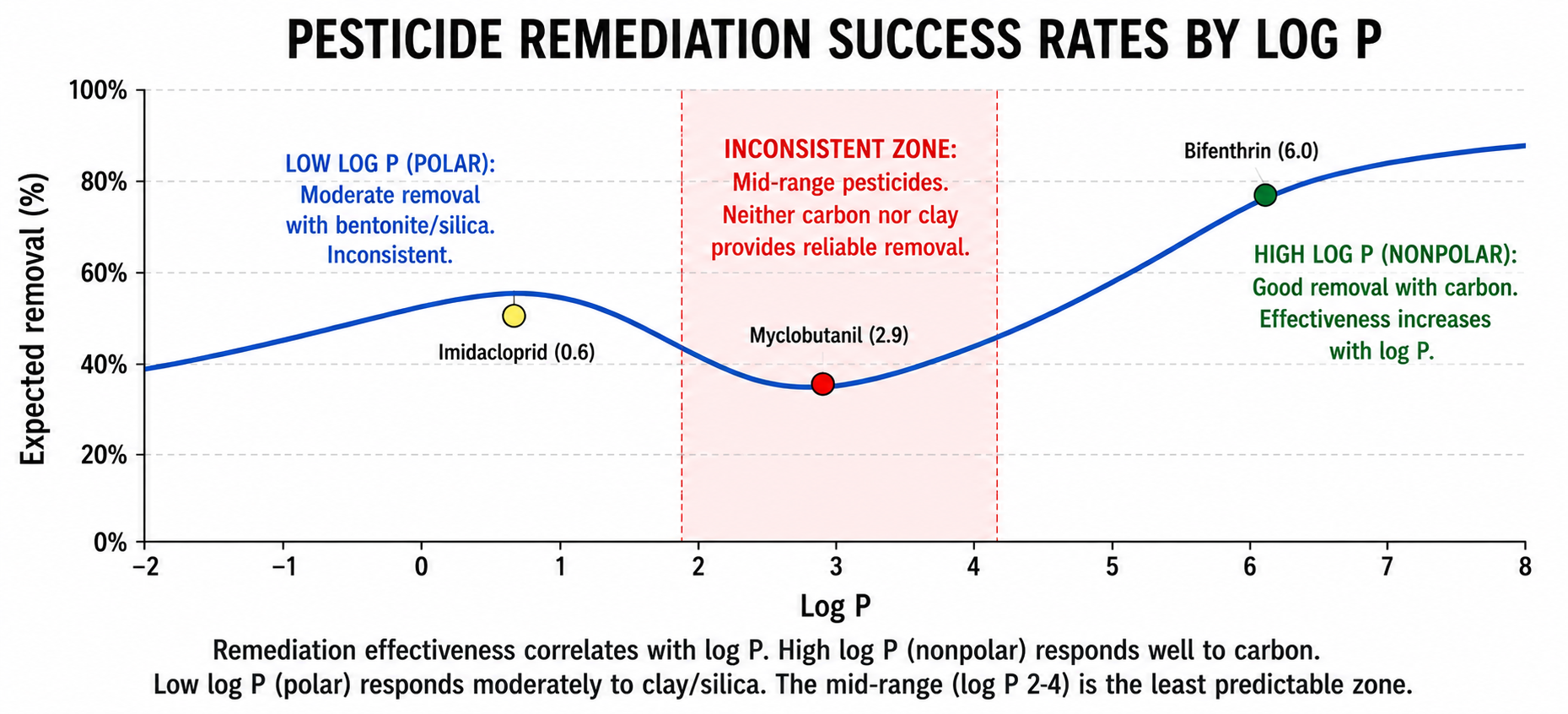
Pesticide remediation is unreliable. Unlike color remediation (where activated carbon predictably removes chlorophyll) or winterization (where cold temperatures predictably crystallize waxes), pesticide remediation has inconsistent success rates. The same adsorbent at the same dose removes 90% of one pesticide and 30% of another. The matrix effects of the crude (cannabinoid concentration, terpene content, lipid loading, pH) all influence the binding behavior in ways that are difficult to predict without empirical testing on the specific batch.
Pesticide remediation is not approved in all jurisdictions. Some states prohibit any attempt to remediate a failed pesticide batch. The batch must be destroyed. Before attempting remediation, verify that your state allows it.
Prevention is the only reliable strategy. Test incoming biomass for pesticides BEFORE extraction (Lesson 1.7.3). A $300 biomass test prevents the $5,000-$20,000 loss of a failed finished product batch. No amount of remediation science replaces the discipline of not processing contaminated starting material.
With that context established, here is the science.
Log P: The Predictive Tool
What Log P Is
Log P (the octanol-water partition coefficient) is a measure of how a molecule distributes between a nonpolar environment (octanol, representing fats and organic matter) and a polar environment (water, representing aqueous systems). It is expressed as a logarithmic ratio:
Log P = log10 (concentration in octanol / concentration in water)
| Log P Value | What It Means | Molecular Character |
|---|---|---|
| Log P > 4 | Strongly prefers the nonpolar phase. Hydrophobic. | Nonpolar, lipophilic. Dissolves readily in oils and fats. Does not dissolve well in water. |
| Log P 2-4 | Moderate preference for the nonpolar phase. | Intermediate polarity. Interacts with both polar and nonpolar environments. |
| Log P 0-2 | Slight preference for nonpolar or roughly equal distribution. | Moderately polar. Significant water solubility. |
| Log P < 0 | Prefers the polar (aqueous) phase. Hydrophilic. | Polar, water-soluble. Does not dissolve well in oils. |
Why Log P Predicts Adsorbent Interaction
The same polarity matching that determines how a pesticide partitions between octanol and water also determines how it interacts with adsorbent media:
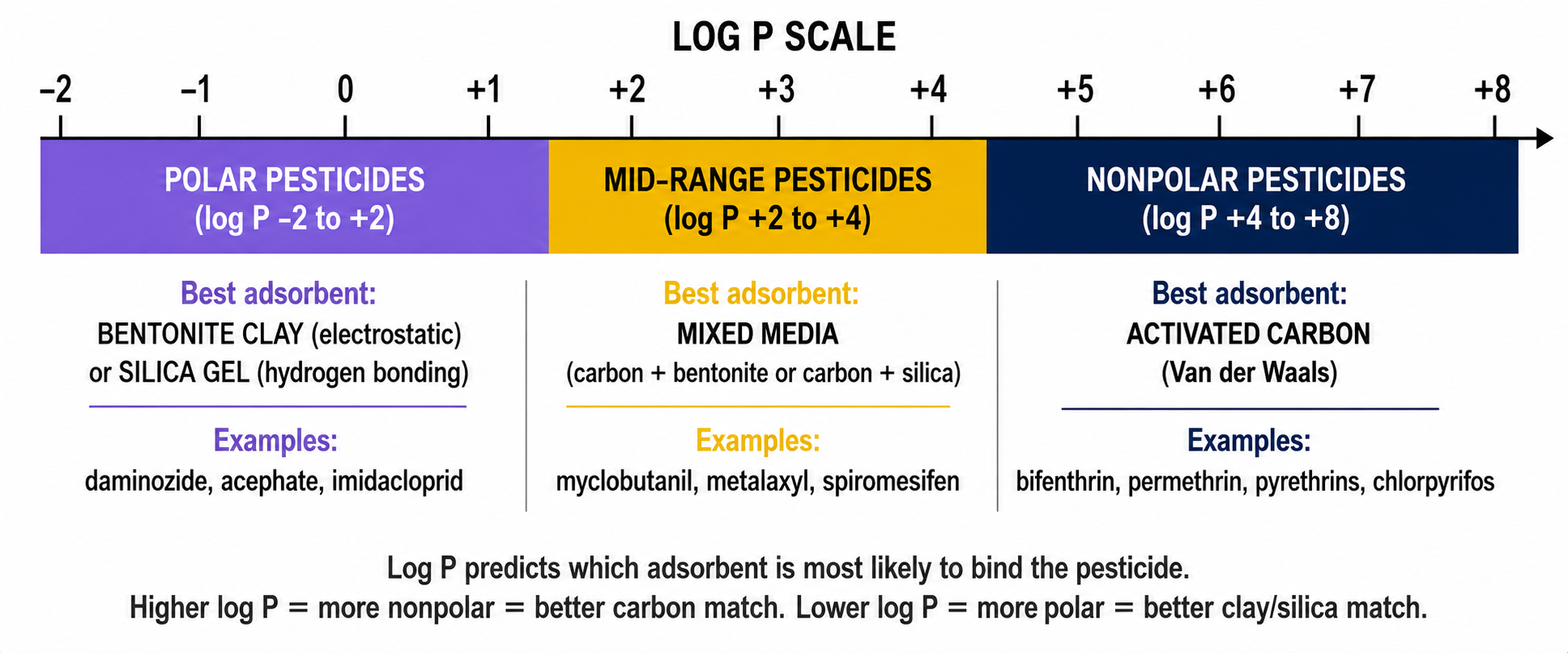
- High log P pesticides (nonpolar) interact strongly with activated carbon through Van der Waals forces in the carbon pore network. Carbon's nonpolar surface attracts nonpolar molecules.
- Low log P pesticides (polar) interact strongly with bentonite clay through electrostatic interaction with the charged clay surface, and with silica gel through hydrogen bonding with the silanol surface.
- Mid-range log P pesticides interact partially with both carbon and polar adsorbents, making them the hardest to predict and often requiring mixed-media approaches.
The Most Commonly Failed Pesticides in Cannabis Testing
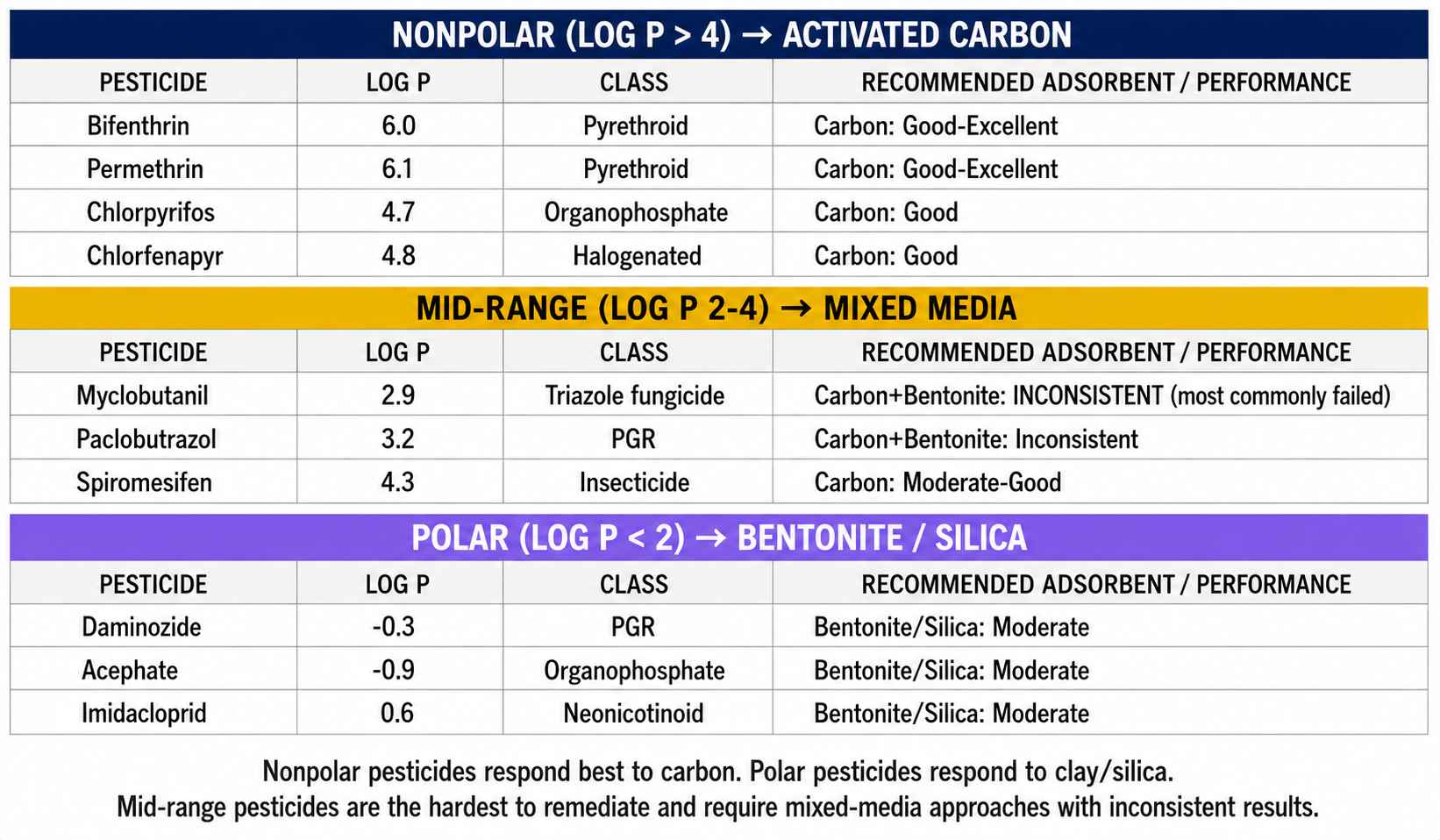
These are the pesticides that cannabis testing labs detect most frequently in failed samples. Each is classified by its log P, polarity class, and the adsorbent most likely to remove it.
Nonpolar Pesticides (Log P > 4): Carbon Targets
| Pesticide | Log P | Type | Common Source | Carbon Removal Effectiveness |
|---|---|---|---|---|
| Bifenthrin | 6.0 | Pyrethroid insecticide | Contaminated soil, spray drift from adjacent non-cannabis agriculture | Good to excellent. High log P = strong Van der Waals binding to carbon. |
| Permethrin | 6.1 | Pyrethroid insecticide | Same as bifenthrin | Good to excellent. |
| Chlorpyrifos | 4.7 | Organophosphate insecticide | Legacy contamination from prior land use | Good. |
| Pyrethrins (natural) | 4.3 | Botanical insecticide | Applied during cultivation as "organic" pest control (but still fails testing if residues exceed limits) | Moderate to good. |
| Chlorfenapyr | 4.8 | Halogenated insecticide | Applied during cultivation | Good. |
Why carbon works for these: Nonpolar molecules with high log P values interact strongly with carbon's nonpolar pore surfaces through Van der Waals forces. The larger the molecule and the more nonpolar its character, the stronger the cumulative Van der Waals attraction to the carbon surface. These pesticides "want" to be on the carbon surface more than they "want" to be in the crude oil solution.
Polar Pesticides (Log P < 2): Bentonite/Silica Targets
| Pesticide | Log P | Type | Common Source | Bentonite/Silica Removal Effectiveness |
|---|---|---|---|---|
| Daminozide | -0.3 | Growth regulator (PGR) | Applied during cultivation to control plant height and increase yield | Moderate. Polar molecule interacts with charged clay surfaces. |
| Acephate | -0.9 | Organophosphate insecticide | Applied during cultivation | Moderate. Very water-soluble. Bentonite or silica provide some binding. |
| Imidacloprid | 0.6 | Neonicotinoid insecticide | Applied during cultivation, systemic (absorbed into plant tissue) | Moderate. Polar enough for clay/silica interaction, but systemic absorption means it is distributed throughout the plant matrix. |
Why bentonite/silica works for these: Polar pesticides have functional groups (amines, hydroxyls, carboxyls) that interact with the charged surfaces of bentonite (electrostatic attraction) and the silanol groups of silica (hydrogen bonding). These are the same interaction mechanisms that make bentonite and silica effective for polar pigment removal in color remediation.
The challenge with polar pesticides: Many polar pesticides are also water-soluble, which means they distribute throughout the crude matrix more uniformly than nonpolar pesticides. Uniform distribution makes adsorption less efficient because the pesticide molecules are not concentrated in the nonpolar phase where they would preferentially contact carbon.
Mid-Range Pesticides (Log P 2-4): The Difficult Zone
| Pesticide | Log P | Type | Common Source | Remediation Approach |
|---|---|---|---|---|
| Myclobutanil | 2.9 | Triazole fungicide | The single most commonly failed pesticide in cannabis testing. Applied during flowering for powdery mildew control. | Mixed media. Carbon provides some removal. Bentonite provides additional removal. Neither alone is highly effective. Sequential treatment (carbon then bentonite) gives the best chance. |
| Paclobutrazol | 3.2 | Growth regulator (PGR) | Applied during cultivation to manipulate plant architecture. Banned in many cannabis jurisdictions. | Mixed media. Similar profile to myclobutanil. Carbon and bentonite in sequence. Results are inconsistent. |
| Spiromesifen | 4.3 | Insecticide/acaricide | Applied during cultivation for mite control. | Carbon (log P approaching the nonpolar zone). Moderate to good with adequate carbon dosing. |
| Metalaxyl | 1.7 | Fungicide | Applied during cultivation for root rot. | Bentonite or silica (log P in the polar zone). Moderate effectiveness. |
Why mid-range is difficult: These pesticides interact partially with BOTH carbon (some Van der Waals binding from their nonpolar portions) and polar adsorbents (some electrostatic or hydrogen bonding from their polar portions), but not strongly enough with either to achieve reliable, complete removal. This is why myclobutanil is the most commonly failed AND the most commonly failed-after-remediation pesticide in the industry.
Remediation Protocols by Pesticide Class
Protocol for Nonpolar Pesticides (Log P > 4)
Media: Powdered activated carbon (PAC), high-surface-area pharmaceutical grade (1,000+ m2/g). Dose: 5-15% of crude weight. Higher dose than color remediation because the pesticide binding competes with cannabinoid binding for the same pore surfaces. Solvent: Dissolve crude in ethanol at 1:10 ratio. Contact time: 30-60 minutes. Longer than color remediation to maximize equilibrium binding. Temperature: Room temperature. Warming does not significantly improve pesticide binding and may accelerate cannabinoid loss. Filtration: DE pre-coat + 1 um filter paper. Two filtration passes recommended (filter once, add the filtrate to a fresh carbon bed, contact again, filter again). Expected removal: 60-90% for high log P pyrethroids (bifenthrin, permethrin). This may or may not bring the batch below the regulatory limit depending on the initial contamination level.
Protocol for Polar Pesticides (Log P < 2)
Media: Bentonite T-5 (acid-activated) or silica gel 60Å. Dose: 5-10% of crude weight. Solvent: Dissolve crude in ethanol at 1:10 ratio. Ethanol's polarity maximizes the interaction between the polar pesticide and the polar adsorbent surface. Contact time: 30-60 minutes. Temperature: Room temperature to 40C. Filtration: Standard (DE pre-coat + 5-25 um paper). Expected removal: 40-70% for polar pesticides. Lower and less predictable than nonpolar removal because polar pesticides distribute uniformly in the ethanol solution and do not concentrate on surfaces as readily.
Protocol for Mid-Range Pesticides (Log P 2-4)
Media: Sequential treatment. Carbon first (30-60 min contact), filter, then bentonite (30-60 min contact), filter. Dose: Carbon at 8-12% + bentonite at 5-8% of crude weight. Solvent: Dissolve crude in ethanol at 1:10 ratio. Contact time: 30-60 minutes per media. Expected removal: 30-60% for mid-range pesticides. THE MOST UNRELIABLE OF ALL THREE PROTOCOLS. Myclobutanil in particular responds inconsistently to every remediation approach tested in the industry.
The uncomfortable truth about myclobutanil: It is the most commonly detected pesticide in cannabis testing, the most commonly failed, and the most resistant to remediation. Its log P of 2.9 places it in the zone where neither carbon nor clay nor silica provides a strong enough interaction for reliable removal. Some batches respond to aggressive carbon+bentonite treatment. Others do not. If your biomass tests positive for myclobutanil above the action limit, the honest assessment is that remediation has a coin-flip chance of succeeding. Pre-extraction biomass testing prevents this entirely.
The Concentration Effect: Why Extraction Makes Pesticide Problems Worse
Even if the biomass passes pesticide testing, the extract may fail. This is the concentration effect from Lesson 1.7.3, applied specifically to pesticides.
Example: A biomass lot tests at 80 ppb for myclobutanil. The regulatory limit for biomass is 200 ppb. The biomass passes.
Extraction concentrates the cannabinoids approximately 5x (from 20% in the biomass to near 100% in the crude, meaning approximately 5 lbs of biomass produce 1 lb of crude). The pesticide concentrates at a similar ratio: 80 ppb x 5 = approximately 400 ppb in the crude.
If the regulatory limit for the finished concentrate is 200 ppb (some states apply the same limit to concentrates as to flower), the crude now fails despite the biomass passing.
This is not a remediation problem. It is a testing and procurement strategy problem. The solution: know your jurisdiction's concentrate limits, calculate the concentration factor for your extraction method, and reject biomass that will produce non-compliant extract even if the biomass itself passes at the biomass limit.
Exercise 2.3.1: Adsorbent-Pesticide Matching
Part A: Log P Classification
For each pesticide, classify it by log P range and identify the primary adsorbent:
| Pesticide | Log P | Polarity Class | Primary Adsorbent |
|---|---|---|---|
| Bifenthrin | 6.0 | ||
| Myclobutanil | 2.9 | ||
| Daminozide | -0.3 | ||
| Paclobutrazol | 3.2 | ||
| Permethrin | 6.1 | ||
| Imidacloprid | 0.6 | ||
| Chlorpyrifos | 4.7 |
Part B: Protocol Design
A batch of crude fails pesticide testing for two compounds simultaneously:
- Bifenthrin at 450 ppb (limit: 200 ppb, log P: 6.0)
- Myclobutanil at 380 ppb (limit: 200 ppb, log P: 2.9)
- What adsorbent do you select for each pesticide?
- Can you treat both in a single remediation pass? Why or why not?
- Design the treatment protocol: media type, dose, contact time, and sequence.
- What is your honest assessment of the probability that this remediation brings BOTH pesticides below 200 ppb?
- If the estimated remediation cost (media, labor, retest) is $500 and the batch value is $8,000, is remediation economically justified?
Part C: Concentration Factor
A hemp processor buys biomass testing at 150 ppb myclobutanil (limit for hemp biomass: 200 ppb, passes). Their extraction concentrates the crude approximately 6x relative to the biomass.
- What will the estimated myclobutanil concentration be in the crude?
- If the concentrate limit is 200 ppb, will the crude pass?
- What myclobutanil level in the biomass would be the maximum acceptable for this extraction process to produce a compliant crude?
- Should the processor accept this biomass? What is the recommended action?
Checkpoint: If Part C calculates the crude concentration as 150 x 6 = 900 ppb (4.5x over the 200 ppb concentrate limit), determines the maximum acceptable biomass level as 200 / 6 = 33.3 ppb, and recommends rejecting the biomass despite it passing the biomass-level test, the student understands that compliant biomass does not guarantee compliant extract and can calculate the concentration factor that determines acceptability.
Key Concept
Note on pricing: All cost and pricing figures in this lesson are estimations based on market conditions at the time of writing. Equipment costs, material prices, and product values fluctuate. Always verify current pricing with manufacturers and suppliers before making purchasing or business decisions.